
Computer Assisted Ancient History
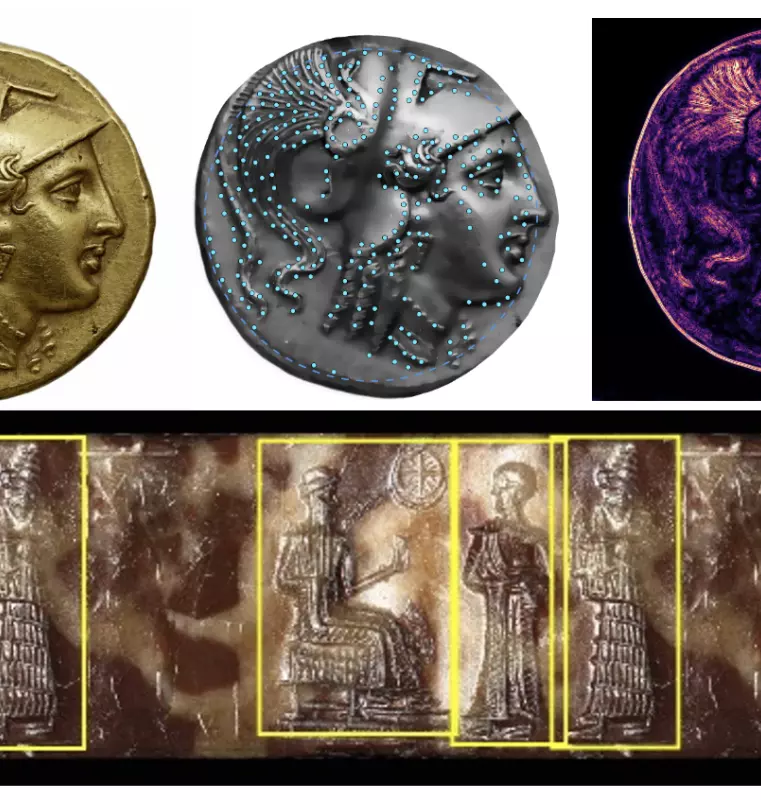
CDLI: For twenty-five years the Cuneiform Digital Library Initiative (CDLI) has catalogued, imaged and transliterated cuneiform sources. Tablets have been imaged with flatbed scanners and HDR photography, seal impressions with additional RTI imaging, and seals have been captured with structured-light scanning using standard capture methods across collections. That work was done for scholars, but it has turned out to be what machines learn from as well.
We present a pilot study on Old Babylonian cylinder seals. Expert annotation with a controlled vocabulary reveals where motifs regularly appear within seal scenes, and an automatic detector trained on 2,491 example annotations finds human figures with 94% accuracy.
We then outline CANVAS, a proposed ERC project that would study seals, early scripts and symbol systems together at the scale of whole corpora.
However, progress in AI raises an uncomfortable question: will general-purpose models simply overtake projects like ours? Early tests with Anthropic of reading cuneiform directly from photographs suggest both how much such models can do and where expert judgement remains essential. We argue that what lasts is not the models but the data, the benchmarks and the questions.
DIEGEST: Die studies — the analysis of matrices used to strike coins — are fundamental to ancient monetary history and to broader questions about mint organisation, coinage circulation, political authority, and economic history at large. Traditionally, die studies have been conducted manually through visual comparison of coin images, a process too labour-intensive for extensive coinages produced by major Greek or Roman imperial mints.
Recent advances in computational analysis, image processing, and machine learning offer new opportunities to automate aspects of die identification and quantification. DIEGEST situates itself at the intersection of numismatics, digital humanities, computer vision, and computational analysis.
We will present the technical challenge of migrating the tool from its current environment at the University College of Singapore, where it was developed by a team of historians and mathematicians, to a non-proprietary online environment at the Ashmolean Museum. This migration is being undertaken by a team of historians, numismatists and developers from Digital Scholarship at Oxford (DiSc). We will also present the groundbreaking transformation in our understanding of ancient and modern economies that DIEGEST will unlock.
The AWRC have reserved a Lunch Table in Hall for Cluster members from 12.30. Lunch will be an opportunity to meet the members of the DIEGEST and CDLI projects. Their talk will start at 13.15 in the Buttery, and will be catered with tea/coffee and cakes (all welcome)